



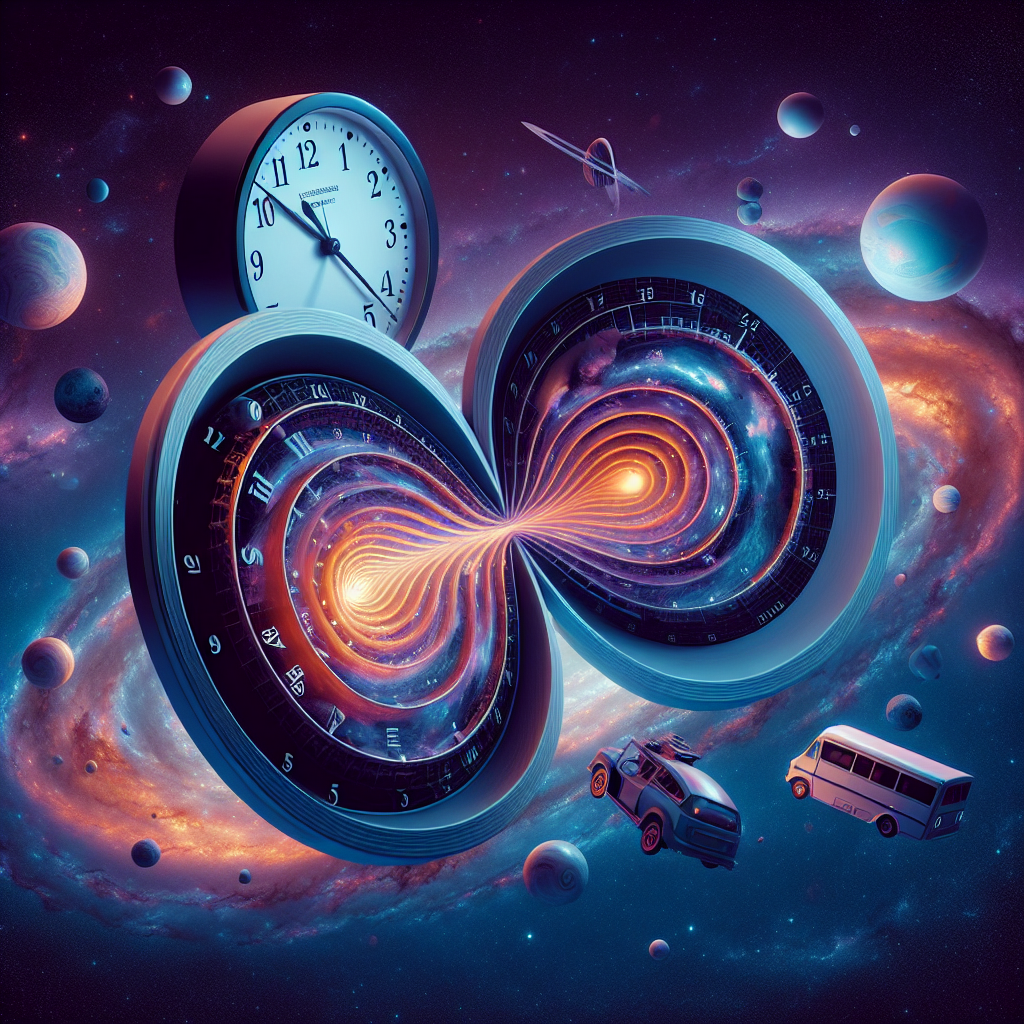
The time paradox is one of the most fascinating puzzles in physics and cosmology., which has baffled scientists and philosophers for centuries. The question of whether it is possible to travel in time, changing the past or predicting the future has intrigued humanity and inspired numerous theories and speculations..
In recent years, Universe simulations have emerged as a powerful tool to study and understand cosmic phenomena that challenge our understanding.. These simulations use mathematical models and supercomputers to accurately recreate the evolution of the universe., from its first moments to the present.
In this sense, the question arises: Can universe simulations help us solve the time paradox? Could these simulations provide us with some clues about the nature of time and its relationship to the universe?? In this article, We'll explore how universe simulations are shedding light on this ancient mystery and whether they could offer any answers to one of the most intriguing questions in physics and cosmology.. Join us on this fascinating journey through universe simulations and their potential to solve the time paradox!!
Discover the fascinating workings of the time paradox and its implications
>
The time paradox is an intriguing concept that has baffled scientists and philosophers for centuries.. It refers to the idea that time can be both linear and cyclical., which raises deep questions about the very nature of reality.
Discover The fascinating operation of the time paradox involves exploring how different scientific and philosophical theories address this question. Some theories suggest that time is an illusion, while others postulate that it is a fundamental dimension that governs our experience of the world.
The implications of the time paradox are vast and complex. For example, what would it mean if time were nonlinear or if it could be traveled backward or forward? How would this affect our understanding of causality and free will??
A fascinating way to address the time paradox is through universe simulations. Some scientists and philosophers suggest that if we live in a computer simulation, It is possible that the rules of time are different from those we know. This could offer an explanation to the time paradox and resolve some of its unknowns..
Through research and reflection, we can discover the fascinating workings of the time paradox and its implications for our understanding of the world.
Discover the fascinating relationship between time and quantum mechanics
>
The relationship between time and quantum mechanics is a fascinating topic that has intrigued scientists and philosophers for decades.. Quantum mechanics, a theory that describes the behavior of subatomic particles, has challenged our traditional understanding of time and led us to question the very nature of reality.
In quantum mechanics, Subatomic particles can exist in multiple states simultaneously, in what is known as quantum superposition. This raises the question of whether time is a fundamental variable or whether it can be influenced by quantum mechanics.. Some theories suggest that time may be an illusion or an emergent construct of quantum mechanics..
Simulations of the universe allow us to explore these fascinating ideas and analyze how time and quantum mechanics interact with each other.. By simulating different scenarios and conditions, we can discover new perspectives on the nature of time and its relationship with quantum mechanics.
Universe simulations: Can they solve the time paradox?
Complete guide: How to create a time paradox step by step
In the world of science fiction, Time paradoxes have been a recurring theme that challenges our understanding of the universe and reality. A time paradox is a situation in which a sequence of events appears to contradict logic or the laws of physics., creating a time loop or a situation that is impossible to resolve.
One way to explore time paradoxes is through creating simulations of the universe. These simulations allow us to recreate hypothetical scenarios and play with the laws of physics to see what happens when they are violated or twisted..
Create a time paradox step by step can be a fascinating and challenging exercise. For this, It is necessary to follow a series of steps that will help us build a scenario in which the laws of time are challenged.
1. Set the rules of the universe: Before we start creating our time paradox, we must define the rules that will govern our simulated universe. Does time travel exist?? What consequences do they have?? Establishing these rules will help us maintain coherence in our narrative..
2. Create the scenario: Once we are clear about the rules, we can begin to build the scenario in which our time paradox will occur. What event will trigger the paradox? Who will be the characters involved?? It's important to think through all the details to create a compelling story..
3. Challenge the rules: The time has come to challenge the established rules and create the time paradox. What happens if a character travels back in time and meets himself?? What effects does this have on the universe?? It is important to think about the implications of our actions and how they will affect the fabric of time..
4. Explore the consequences: Once we have created the time paradox, we can explore the consequences of this situation. Does it create a time loop? Are there irreversible changes in the universe?? Analyzing the implications will help us better understand the paradoxes of time and their possible solutions..
Through creating what-if scenarios and manipulating the rules of physics, we can challenge our understanding of time and the universe we live in. Could these simulations help us solve the time paradox? That is a question that has yet to be answered..
Discover the fascinating explanation behind the quantum paradox
>
The quantum paradox is one of the most intriguing phenomena in quantum physics.. It refers to the idea that a particle can be in two places at the same time., or that two particles can be entangled in such a way that what happens to one instantly affects the other, regardless of the distance that separates them.
This paradox has baffled scientists for decades, as it defies human logic and intuition. However, Some theories suggest that the quantum paradox could be resolved through simulations of the universe.
Universe simulations are computer models that recreate the universe in all its dimensions and complexities.. These simulations can help scientists better understand quantum phenomena and find explanations for paradoxes that arise in quantum physics..
One of the most fascinating theories is the idea that we live in a computer simulation, similar to a video game. According to this theory, our universe would be a simulation created by an advanced civilization, and quantum paradoxes would simply be errors in the programming code.
If this theory turns out to be true, We could solve the time paradox and other quantum paradoxes by better understanding how the simulation of the universe works. This would open the door to new possibilities and discoveries in quantum physics., and would lead us to rethink our understanding of reality and the universe as a whole..
As we advance our understanding of the nature of reality, It's exciting to think about the possibilities that open up before us..
In summary, Universe simulations can be a valuable tool for exploring the time paradox and better understanding our place in the cosmos.. As we continue to research and expand our knowledge on this fascinating topic, It is important to keep an open mind to new ideas and theories. If you are interested in delving deeper into this exciting topic, We invite you to give away books created by Verbalus Mater, that creatively and accessiblely address the complexities of time and the universe. Don't miss the opportunity to broaden your horizons and immerse yourself in the exciting world of physics and cosmology!!