



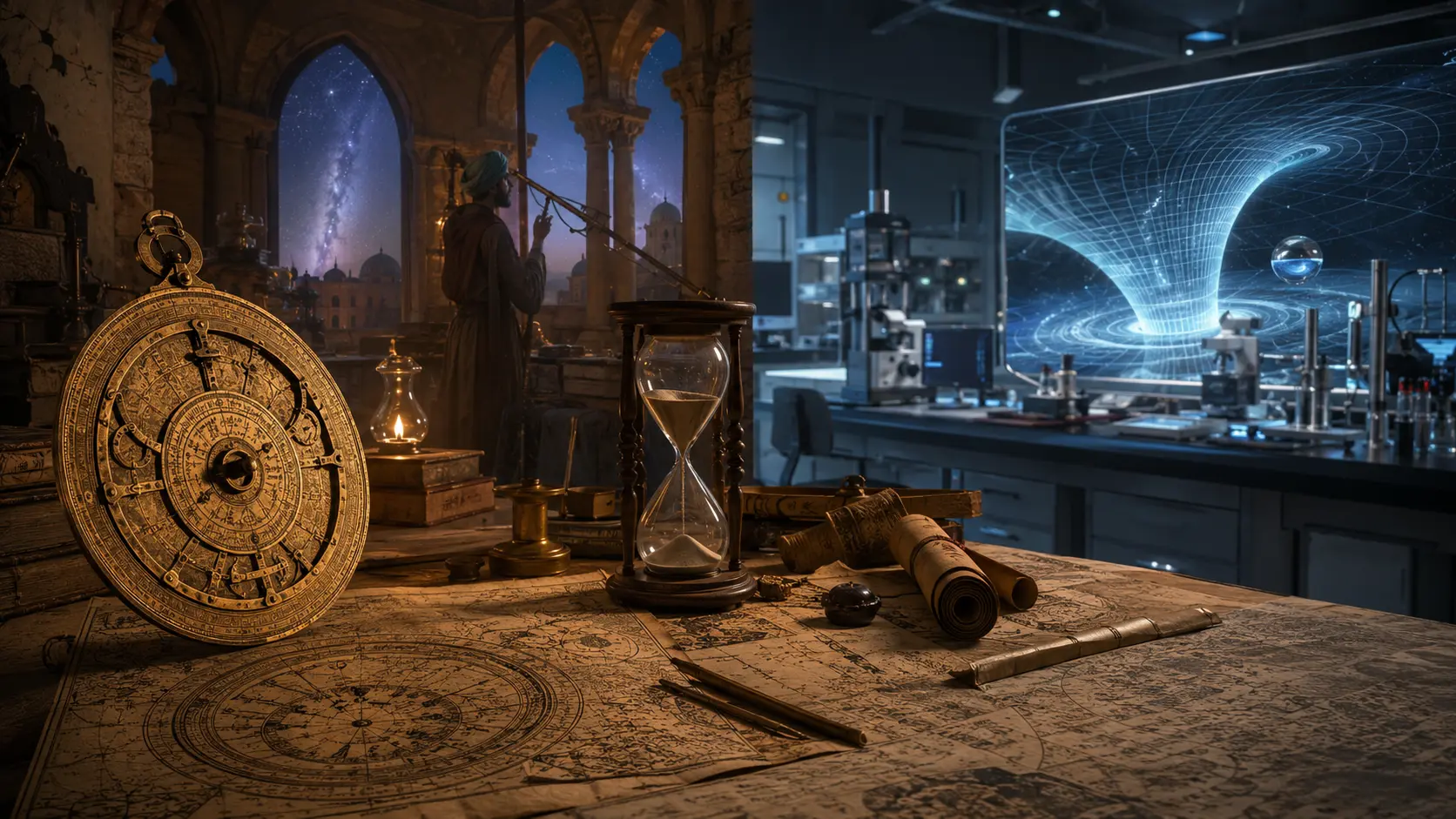
The history of time It is also the story of how human beings learned to relate change, memory, sky and social organization. Time did not come to our cultures as a finished concept. It was first observed in the movement of the Sun, the phases of the moon, the seasons, growth and death. Then it became a calendar, philosophical argument, physical magnitude and dimension of the universe.
Going through this transformation avoids a common mistake: imagine that all eras understood time like we do. A digital clock has homogeneous units available at any time; an agricultural community could live according to sunrises, seasons and events. No society lacked temporality, but each one highlighted rhythms, symbols and different needs.
Look at the sky to order life
Astronomical cycles offered visible regularities. The alternation of light and darkness organized activity and rest. The Moon provided a recognizable sequence and the solar year marked seasons. Observing these repetitions helped predict migrations, crops, floods and celebrations. Measuring time was a way to coordinate with the environment.
Calendars were never simple copies of heaven. The lunar and solar cycles do not fit exactly into a whole number of days, so cultures developed adjustments, leap months and rules. A calendar is a mathematical and political technology: decide beginnings, festivities, taxes, Collective memory and authority to correct the count.
Ancient monuments and observatories show sophisticated attention to celestial orientations and phenomena, although it is advisable to avoid attributing the same purpose to everyone. An alignment can have ritual functions, practical or symbolic. Understanding the past requires respecting the evidence and not projecting modern theories without support.
Cyclic time and linear time
It is often stated that ancient cultures thought cyclically and modern cultures thought linearly.. The distinction is useful, but too rigid. The days and seasons repeat, as biographies progress from birth to death. Reigns form sequences and rituals return. Cycle and line can coexist in the same vision.
Cyclical time highlights renewal and recurrence. The linear underlines origin, development and destiny. Religious and philosophical traditions combined both in numerous ways: ages of the world, genealogies, eras, returns and unique events. These images were not just abstract theories; guided expectations and responsibilities.
Philosophers and the problem of change
Ancient philosophy turned time into a conceptual problem. If everything changes, what remains?, Can movement exist if to reach a point you have to travel through infinite divisions??, Is time real or a measure of change? The paradoxes of the movement forced us to think about continuity, infinity and divisibility.
A line of reflection linked time with the number of the movement according to a before and after. This suggests that measuring requires comparable changes and a mind capable of counting them.. Another tradition highlighted the tension between a mutable world and a permanent reality. Many current questions—whether time is of the essence, relational or emergent—preserve echoes of those debates.
In the experience, the present seems to escape: The past is gone and the future is not yet. If the present had no extension, how could a duration be composed? Later thinkers explored memory and expectation as ways in which the soul or mind gathers absent times.. The relationship between time and consciousness has deep roots.
shadow clocks, water and sand
Measuring intervals less than a day required instruments. Sundials took advantage of the position of a shadow, but they depended on the weather, latitude and season. Water clocks used the flow of water; the hourglasses, the passage of grains between containers. Each method transformed a continuous change into a repeatable reference.
These devices did not produce the uniformity of an atomic clock, but they allowed speeches to be regulated, guards, rituals and tasks. Its importance is conceptual: a duration could be compared to a controlled artificial process. Little by little, time was separated from a specific event and converted into a transferable quantity.
The mechanical watch revolution
Medieval mechanical clocks and their later improvements changed the social relationship with time. An oscillating mechanism divided the day into regular units and a bell coordinated people who were not looking at the sky. Accuracy gradually increased; Minutes and seconds acquired a daily presence when instruments could represent them reliably..
An instant transformation should not be imagined. For centuries solar hours coexisted, local times, uneven bells and clocks. However, mechanization favored a powerful idea: The universe could be compared to a mechanism and time moved forward uniformly.. The clock not only measured a previous conception; helped make it imaginable.
Navigation drove decisive improvements. Determining geographic longitude required comparing local time with a reference preserved during the trip. Creating sufficiently stable chronometers was a scientific challenge, artisanal and economical. Measuring time accurately allowed us to measure space.
The absolute time of classical physics
Early modern physics sought universal mathematical laws. In classical mechanics, It was natural to treat time as a homogeneous variable that flows in the same way for everyone.. With that structure, Positions and velocities could be calculated and orbits described with extraordinary precision..
The idea of absolute time was not simple naivety. Worked excellently for ordinary gravitational fields and velocities. It allowed terrestrial and celestial movements to be unified under the same laws. still today, Many engineering calculations use classical approximations because relativistic corrections are negligible on their scale..
At the same time, relational visions emerged: perhaps time is not an independent substance, but the order between changes. If all events disappeared, would it still happen? The debate between an absolute structure and relations between objects anticipated contemporary discussions.
Thermodynamics and the arrow of time
Mechanical laws often allow mathematical inversion of motion.. However, The macroscopic world has an obvious direction: a glass falls and breaks, but the fragments do not come together spontaneously. Thermodynamics introduced entropy and a statistical description of irreversible processes.
The second law indicates that, in isolated systems, macroscopic states evolve with enormous probability towards configurations of higher entropy. This thermodynamic arrow of time connects past and future with conditions of the universe. Explaining why the cosmos began in a state of sufficiently low entropy remains a profound question..
Memory seems to align with that arrow. We preserve records of the past in brains, photographs and physical prints; we do not have equivalent records of the future. Creating a record requires thermodynamic processes. The lived direction of time cannot be completely studied apart from the physical structure that allows information to be preserved..
Standardization, railway and social time
While each locality used its solar time, small differences hardly mattered. Railroads and telegraphs quickly connected cities and made incompatible schedules problematic.. Standardization and time zones transformed local noon into a coordinated convention.
This reveals a double dimension. The Earth's Spin Provides a Physical Basis, but the border between zones and the legal time are agreements. Just because something is conventional does not mean arbitrary or false.; means that several solutions would be possible and a society chooses one to coordinate with. Civil time is a shared infrastructure.
Einstein and the end of universal simultaneity
Special relativity showed that observers in relative motion can disagree about the simultaneity of distant events and, even so, relate your measurements using exact rules. The speed of light plays an invariant role. Space and time are no longer separate scenarios and are integrated into space-time..
The consequence is radical: there is no single cosmic clock that defines the same present everywhere. Each trajectory has its own time. Relatively moving clocks can accumulate different durations between encounters. This effect is not limited to an elegant theory; has been verified and should be considered in precision technologies.
General relativity expanded the change. Gravity is described as the geometry of space-time and affects the rhythm of clocks. Matter and energy influence the structure where bodies move. Time went from a universal container to a dynamic component of the universe.
Cosmology: did time have a beginning?
Cosmological models describe an expanding universe whose history can be extrapolated to extremely dense and hot states.. Talking about the Big Bang as an explosion in empty space is misleading.: is the expansion of the space itself described by the model. Asking what happened “before” may be legitimate in some theories and undefined in others..
General relativity finds limits when approaching conditions where quantum effects should dominate. That's why, we don't know if time began, emerged from an earlier phase or takes another form in a theory of quantum gravity. Different proposals explore rebounds, phases without classical time or more fundamental structures, but not all have equivalent evidence.
Weather in the atomic age
The modern unit of time is defined by a reproducible atomic frequency. Atomic clocks achieve extraordinary stability and allow gravitational differences associated with even modest changes in height to be detected.. Precision turns relativity into an everyday metrology issue.
Navigation, telecommunications, research and financial networks depend on synchronization. We no longer measure time just to know the time: we distribute a reference that supports global systems. As precision increases, so does the need to specify trajectory, severity and comparison method.
Contemporary philosophy: gift, block and becoming
The loss of universal simultaneity fueled interpretations where past, present and future form a four-dimensional structure. Other positions attempt to preserve a fundamental present or an objective future.. Physics restricts options, but translating an equation into a thesis about what exists requires additional philosophical arguments.
It is also debated whether time emerges from deeper relationships, whether direction depends on initial conditions and how conscious experience fits in. There is no single “scientific view” that automatically resolves these questions.. Yes there is a commitment: any interpretation must respect the experimental results.
Science fiction and the popularization of time travel
Literature transformed ancient visions, dreams and trips to worlds with different rhythms in machines and procedures. The modern time traveler not only receives a prophecy: manipulates a technology and faces causal consequences. Cine, television and video games developed branching lines, loops and mutable pasts.
These works influence our intuition. Words like portal, dimension or timeline are now part of popular language. Its cultural value is enormous, but it is convenient to distinguish narrative rules from verified hypotheses. A story can be philosophically revealing even if its mechanism is not possible.
What do we learn from this journey?
History does not advance by simply replacing superstition with truth. Each stage created instruments, concepts and questions adapted to your problems. Calendars combined astronomy and society; mechanical watches made regularity visible; classical physics discovered powerful laws; relativity redefined measurements; cosmology opened questions about the origin.
We also learn that measuring changes what is measured only in a cultural sense., not necessarily physical. The clock disciplined days and coordinated networks, but he did not invent the earth's rotation. Human categories select real aspects and turn them into infrastructure.
Follow the thread of time
Studying this history in order allows us to understand why a phrase like “time is relative” has a very different technical meaning from “each person feels time in their own way.”. TimeTravelers.cc connects the evolution of ideas with relativity, temporal fiction and consciousness so that each concept preserves its context.
Time is simultaneously a magnitude, a structure, an experience and a social institution. No isolated definition exhausts the phenomenon. The best route combines history, science and philosophy, pointing out at each step what kind of question we are asking.
Frequently asked questions about the history of time
Who invented time?
Nobody invented change or natural cycles. Societies developed calendars, units and instruments to measure and coordinate them.
Did you always have an hour and sixty minutes?
Not all cultures divided the day equally. The current divisions come from a history of number systems, astronomy, instruments and standardization.
Did Einstein say time is an illusion??
Relativity shows that duration and simultaneity depend on motion and gravity according to precise laws.. The philosophical claim that time is an illusion requires additional arguments.
Did time begin with the Big Bang?
Classic models reach an early limit, but a complete quantum theory could change that picture. There is no definitive answer about a “before” applicable to all proposals.
Why were time zones created??
Rapid communication and transportation made it necessary to coordinate schedules between locations that used different solar hours.