



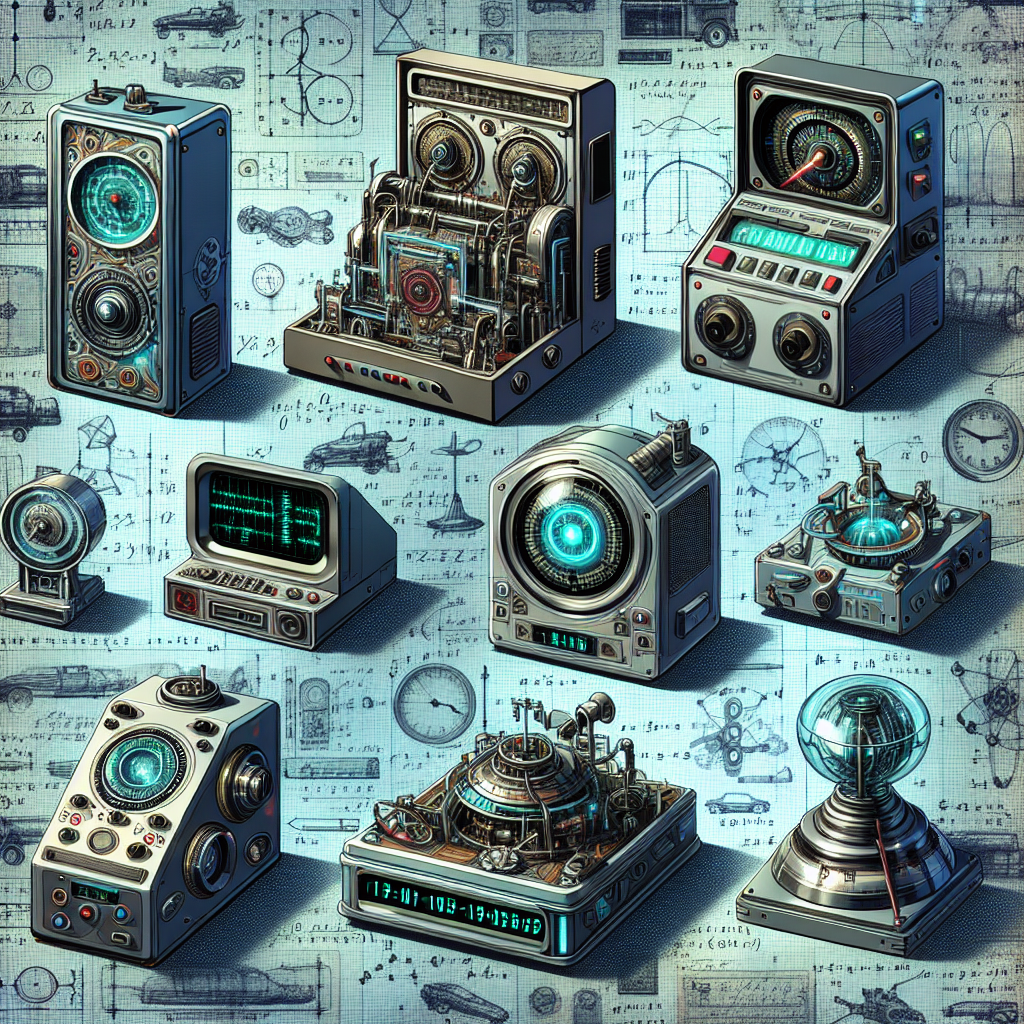
In scientific literature, the concept of time machines has fascinated writers, scientists and researchers for centuries. The idea of traveling through time and changing past or future events has been explored in numerous literary works., from classics like “The time machine” de H.G. Wells to science fiction films like “Back to the Future”.
But, How realistic are these depictions of time machines in scientific literature really?? In this essay, We will analyze the different scientific theories that support the possibility of time travel, as well as the limitations and challenges we would face if we tried to build a time machine in real life.
We will explore the ethical and philosophical implications of changing past or future events, as well as the possible temporal paradoxes that could arise from time travel. Besides, We will examine how scientific literature has influenced our understanding and perception of time machines throughout history..
Discover why it is impossible to build a time machine: myths and realities
>
Time machines have been a recurring theme in scientific and science fiction literature., capturing the imagination of many people over the years. However, despite its popularity in popular culture, the idea of building a time machine real presents a series of scientific challenges that make it impossible in practice.
One of the main myths surrounding time machines is the idea that you can physically travel to the past or future., as if it were a vehicle that transports us from one place to another. However, according to Einstein's theory of relativity, travel in time physically would present a series of paradoxes that defy the laws of physics, like the grandfather paradox or the time traveler paradox.
Another common myth is the idea that a time machine can be built using advanced technology., such as wormholes or manipulation of gravitational fields. Although these ideas are fascinating in theory, In practice we are still far from being able to develop technology that allows us to travel in time in a way effective and safe.
Although we cannot rule out the possibility that some progress will be made in this field in the future., For now, it is important to understand that time machines remain a distant dream and not a tangible reality..
Discover the meaning and operation of the time machine in science fiction
The time machine is a recurring concept in science fiction literature., where it is used to transport characters to different times in the past or future. This idea was popularized by the novel “The time machine” de H.G. Wells, published in 1895.
in science fiction, The time machine is presented as a technological device capable of bending or breaking the barriers of time, allowing those who use it to travel through different eras. This concept defies the laws of physics known until now., since it implies the possibility of traveling through time in a non-linear way.
The operation of the time machine varies depending on the work in which it is presented. In some stories, It is a physical machine with buttons and levers that are activated to select the time to which you want to travel.. In others, the time machine is a more abstract phenomenon, like a wormhole or a distortion in space-time.
Despite its popularity in science fiction literature, the existence of a real time machine in real life is highly unlikely. Scientists have not yet found a viable way to travel through time in a controlled and safe manner, and theoretical concepts such as wormholes or relativity are still the subject of debate and study.
Although it is a fascinating concept and has inspired numerous works of literature and cinema, Its viability in real life is questionable. The time machine remains a topic of speculation and fantasy in science fiction.
Is it possible to travel back in time to the past? Discover the answer here
In scientific literature, Time machines have been a recurring topic that has generated great interest and debate. The possibility of time travel to the past has been explored in numerous works of science fiction., But how realistic are these representations??
First of all, It is important to note that the idea of time travel to the past poses numerous challenges from a scientific point of view.. According to Einstein's theory of relativity, time is another dimension, along with space, and is intrinsically linked to gravity. Therefore, any attempt to manipulate time would require a deep understanding of these concepts.
In scientific literature, Various theories and scenarios have been proposed to explain how it would be possible to travel back in time to the past.. Some of these theories involve the creation of wormholes, the manipulation of gravitational fields or the use of advanced technologies that do not yet exist.
It is important to keep in mind that so far, There is no solid scientific evidence to support the possibility of time travel to the past.. Although the idea of Time Machines is fascinating and has inspired numerous works of fiction, Its real-world viability remains a mystery..
Although science fiction allows us to explore the limits of the imagination, the reality of Time Machines remains a distant dream.
Discover who was the genius behind the attempt to create the time machine
>
In scientific literature, las time machines have been a recurring theme that has captured the imagination of writers and readers alike. The idea of being able to travel through time has been explored in numerous works, from science fiction classics to serious academic research.
One of the most famous attempts to create a time machine It was proposed by the physics genius, Albert Einstein. Although Einstein is best known for his theory of relativity, He also had ideas about the possibility of time travel.. In his theory of relativity, Einstein suggested that time and space are interconnected, which raises the theoretical possibility that time travel is possible.
Another genius who has explored the idea of time machine In scientific literature it is the writer H.G.. Wells. In his novel “The time machine”, published in 1895, Wells introduces the idea of an invention that allows travel through time. Through the story of its protagonist, the Time Traveler, Wells explores the ethical and philosophical implications of the possibility of time travel.
Wells. Although the possibility of time travel remains a mystery, the idea of time machine continues to fascinate scientists and readers alike.
In conclusion, Time machines in scientific literature can be fascinating and stimulating to our imagination., but it is important to remember that for now they are still just fiction. However, Scientific literature invites us to reflect on time, reality and the possibility of time travel. Why not gift a Verbalus Mater book to your loved ones so they can explore these ideas for themselves and discover new ways of thinking about time and reality.? Give a book and give a world of possibilities!