



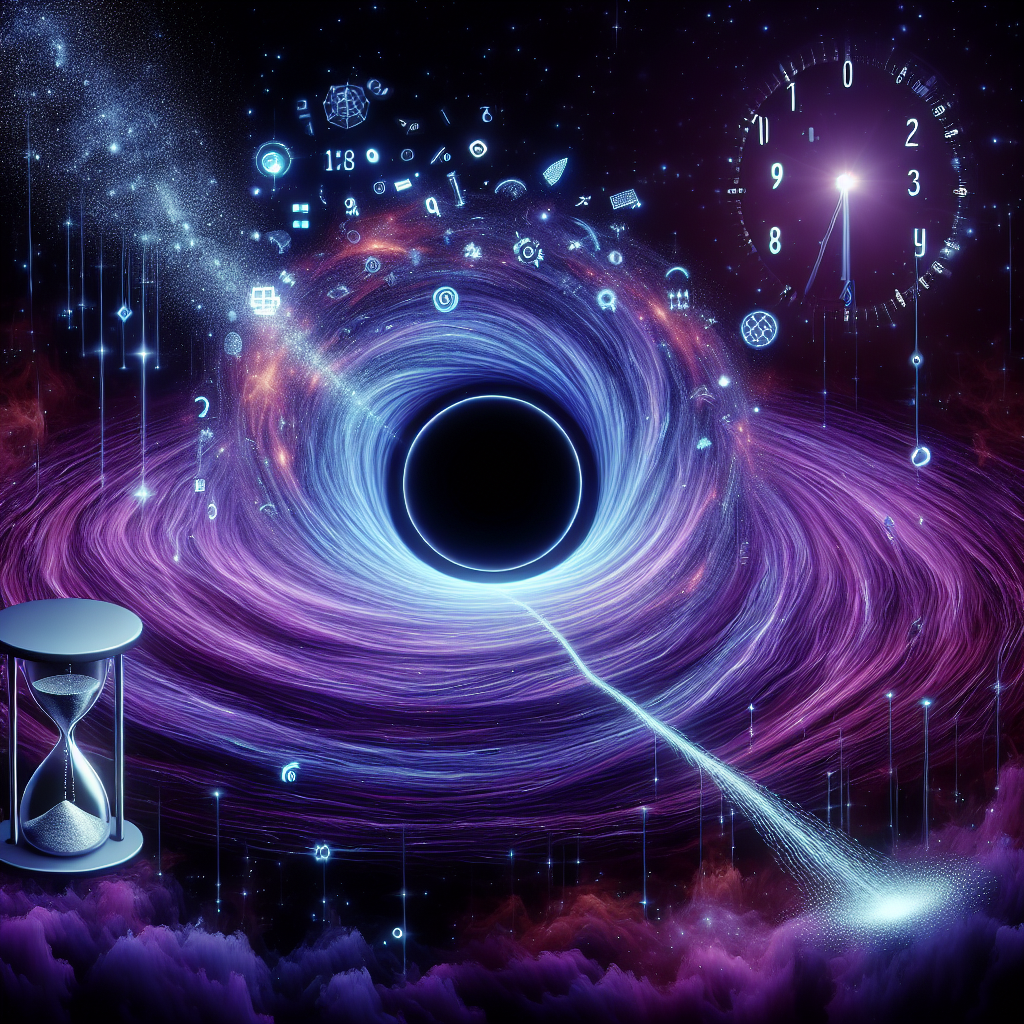
Black holes are one of the most enigmatic and fascinating phenomena in the universe.. Their powerful gravity is capable of devouring all matter and light that approaches them., creating an environment where the laws of physics as we know them seem to defy our understanding. In the midst of this complexity, The paradox of information arises in black holes and its relationship with time, an enigma that has baffled scientists for decades.
In this presentation, We will explore how Einstein's theory of relativity and quantum mechanics intertwine in the study of black holes., and how this interaction raises questions about the conservation of information in these cosmic objects. What happens to the information that is absorbed by a black hole? Is it lost forever or can it be recovered somehow?? These questions lead us to reflect on the nature of time and its relationship with quantum physics., opening new doors to understanding the universe and its mysteries.
Join us on this journey through black holes and the information paradox, where the border between reality and theory blurs, and where the answers to our questions may be closer than we imagine.
Discover the black hole information paradox: simple and clear explanation
In the physics of black holes, There is a concept known as the information paradox. This paradox refers to the apparent contradiction between Einstein's theory of general relativity and quantum mechanics..
According to the theory of general relativity, A black hole is an extremely dense object that has a gravitational field so intense that not even light can escape from it.. This means that any information that falls into a black hole, including information on the structure and composition of matter, is lost forever.
On the other hand, Quantum mechanics maintains that information is never destroyed, but it simply transforms into different forms. This raises a fundamental dilemma: if the information cannot be destroyed, How is it possible to disappear into a black hole??
The black hole information paradox has baffled physicists for decades. A possible solution to this puzzle is the idea that information is not destroyed in a black hole., but is somehow preserved on the surface of the event horizon. This theory suggests that information can be recovered from a black hole through complex quantum processes..
As scientists continue to explore this fascinating phenomenon, It is likely that new theories and discoveries will emerge that will bring us closer to a definitive solution to this cosmic enigma..
What happens over time in black holes? Discover its impact on the universe
>
The information paradox in black holes is one of the most fascinating puzzles in modern physics.. What happens over time in these mysterious cosmic objects? The answer to this question could have a profound impact on our understanding of the universe.
in a black hole, gravity is so intense that nothing, not even the light, can escape your attraction. This means that time behaves very differently than it does in the rest of the universe.. According to Einstein's theory of relativity, time slows down as we get closer to a massive object, like a black hole. This means that to an outside observer, Time in a black hole stops completely at the event horizon, the border from which nothing can escape.
The information paradox arises when we consider what happens to the information of matter that falls into a black hole. According to quantum theory, information cannot be destroyed, but in a black hole it seems that it is lost forever. This has led to a heated debate among physicists about the nature of information in black holes and its relationship to time..
The impact of this paradox on our understanding of the universe is enormous.. If information is lost in black holes, This could challenge some of the fundamental ideas of physics, how to preserve information. On the other hand, If we find a solution to this paradox, We could be one step closer to understanding the true nature of gravity and time in the cosmos.
The information paradox in these cosmic objects forces us to rethink our ideas about time and gravity, and its impact on the universe could be revolutionary.