



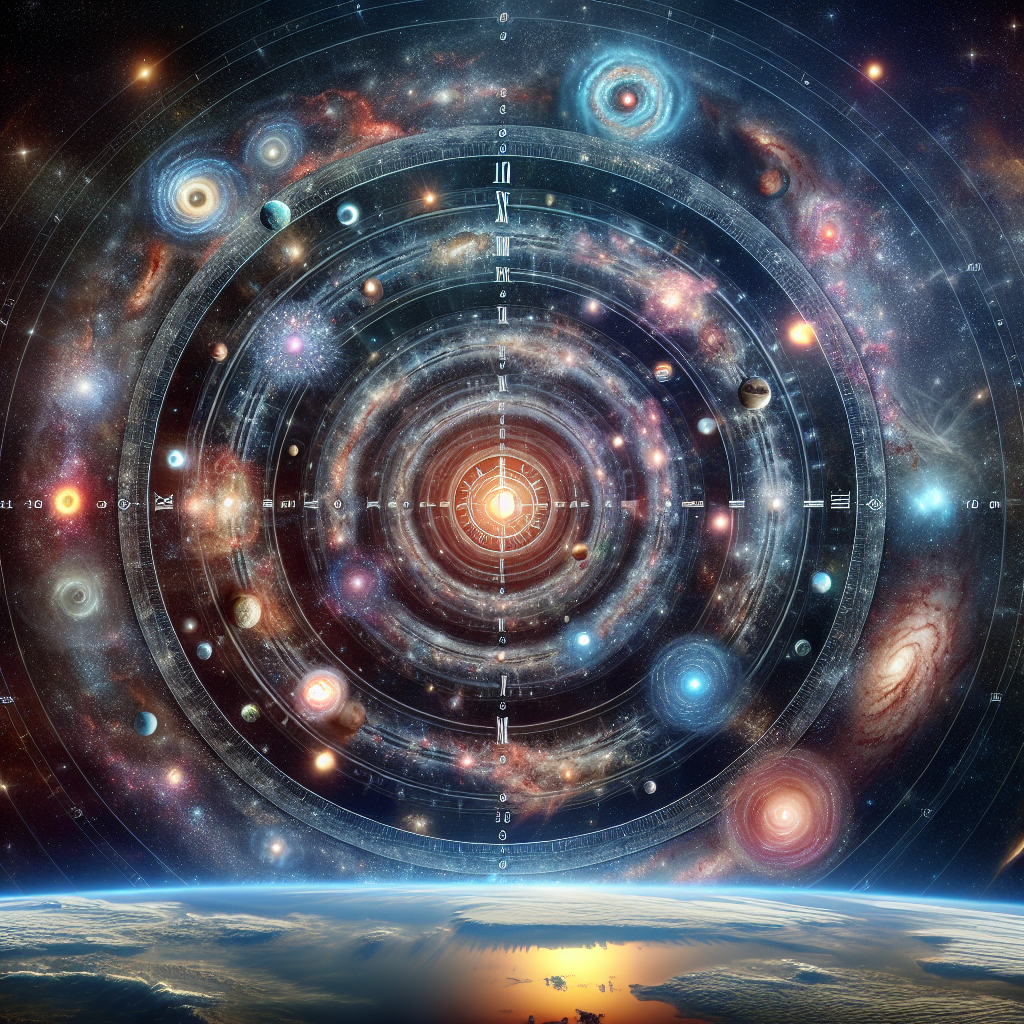
The universe has always been a fascinating topic for humanity, with questions that range from its origin to its final destination. One of the most intriguing theories to emerge in recent years is the idea that the universe could be a time loop., that is to say, that repeats itself over and over again in an eternal cycle.
This theory raises the possibility that the universe is not linear., but repeats itself over and over again in an infinite cycle of creation, expansion, contraction and destruction. If this hypothesis turns out to be true, It would mean that our current reality is nothing more than one of the many iterations of a universe in constant renewal.
In this presentation, We will explore the evidence for and against the time loop theory, as well as the philosophical and scientific implications it would have if it were true. Are we trapped in an eternal return, with our lives and our decisions predestined to repeat themselves over and over again? Or is there a chance to break this cycle and change our destiny? Join us on this fascinating journey across the frontiers of physics and metaphysics as we attempt to answer the question: Is the universe a time loop?
Everything you need to know about the space-time loop: definition, examples and theories
The concept of a space-time loop is a fascinating theory that has been the subject of debate and speculation in the field of physics and cosmology.. In a nutshell, A space-time loop is a structure in which time and space curve back on themselves in such a way that they form a closed loop.. This means that, in theory, one could travel back in time and return to the same point in space where one started.
This idea has been explored in science fiction and literature, but it has also been the object of study in theoretical physics. Some theories suggest that space-time loops could be possible in the universe, although its existence has not yet been conclusively proven.
To better understand this concept, It is useful to examine some examples. Imagine a space-time loop in which an object travels back in time and encounters itself at an earlier moment.. This could result in temporal paradoxes, like the well-known grandfather paradox, in which a person travels to the past and prevents their grandparents from meeting each other, which in turn would prevent his own birth.
Regarding the theories that support the existence of space-time loops, One of the best known is the theory of general relativity of Albert Einstein. According to this theory, Gravity is a curvature in space-time caused by the presence of mass and energy. This curvature could theoretically allow the existence of space-time loops, although experimental evidence is still lacking to confirm this possibility.
Although its existence has not yet been definitively proven, Its study and exploration continue to fascinate scientists and enthusiasts alike..
Find out if the universe is trapped in an infinite loop: the theory behind the eternal cycle
Is the universe a time loop? This intriguing question has captured the imagination of scientists and philosophers for centuries.. The theory behind the eternal cycle suggests that the universe may be trapped in an infinite loop, repeating events and processes over and over again.
According to this theory, the universe expands, It contracts and then expands again in an endless cycle. This eternal cycle raises fascinating questions about the origin of the universe, its destiny and our own existence in it.
Proponents of this theory suggest that the time could itself be cyclical, with past events, Presents and futures happening over and over again in an infinite loop. This challenges our linear perception of time and raises the possibility that our lives are destined to repeat themselves over and over again..
for some, this idea is terrifying, as it raises the possibility that we are trapped in a infinite loop of experiences and decisions. For others, this theory is exciting, since it suggests that the universe is a place of infinite possibilities and opportunities.
Scientists continue to investigate this theory, looking for evidence that supports or refutes the idea of an eternal cycle. Until then, We will continue to marvel at the vastness and complexity of the universe and the existential questions it raises..
Discover the theory of the cyclic universe: explanation and examples
The theory of the cyclical universe puts forward the idea that the universe undergoes infinite cycles of expansion and contraction.. According to this theory, the universe expands until it reaches a maximum point in size and then begins to contract until it reaches a minimum point, and then expand again.
This theory suggests that the universe is not a linear process, but follows a cyclical pattern of creation and destruction. In this sense, You could say that the universe is a bucle temporal, in which cycles of expansion and contraction repeat over and over again.
An example that is often used to illustrate this theory is that of a spring that continuously stretches and contracts.. In this case, The spring represents the universe and its movement of expansion and contraction symbolizes the infinite cycles to which it would be subjected..
If this theory turns out to be true, would mean that the universe is a time loop in which the same events repeat over and over again in an endless cycle.
Discover how the universe is considered: scientific and philosophical perspectives
>
The concept of whether the universe is a bucle temporal has been the subject of debate both in the scientific community and in philosophy. From a scientific perspective, Some theorists suggest that the universe could be undergoing infinite cycles of expansion and contraction, which would imply that time is cyclical and that everything repeats itself over and over again.
On the other hand, from a philosophical perspective, The debate centers on whether the universe has a defined beginning and end, or if it is eternal and has always existed. Some philosophers argue that the idea of a time loop implies a lack of meaning in existence., since everything would be predestined and without the possibility of change.
Exploring these perspectives can help us better understand the nature of the universe and our place in it..
In conclusion, The theory that the universe is a time loop raises fascinating questions about our existence and the passage of time. Although there are no definitive answers yet, It is important to continue exploring and questioning our environment to expand our horizons.. If you are interested in delving deeper into these topics, I encourage you to give books created by Verbalus Mater, where you will find reflections and theories that will make you think differently about the universe and our reality. Dare to explore new horizons and discover the fascinating world of knowledge!!