



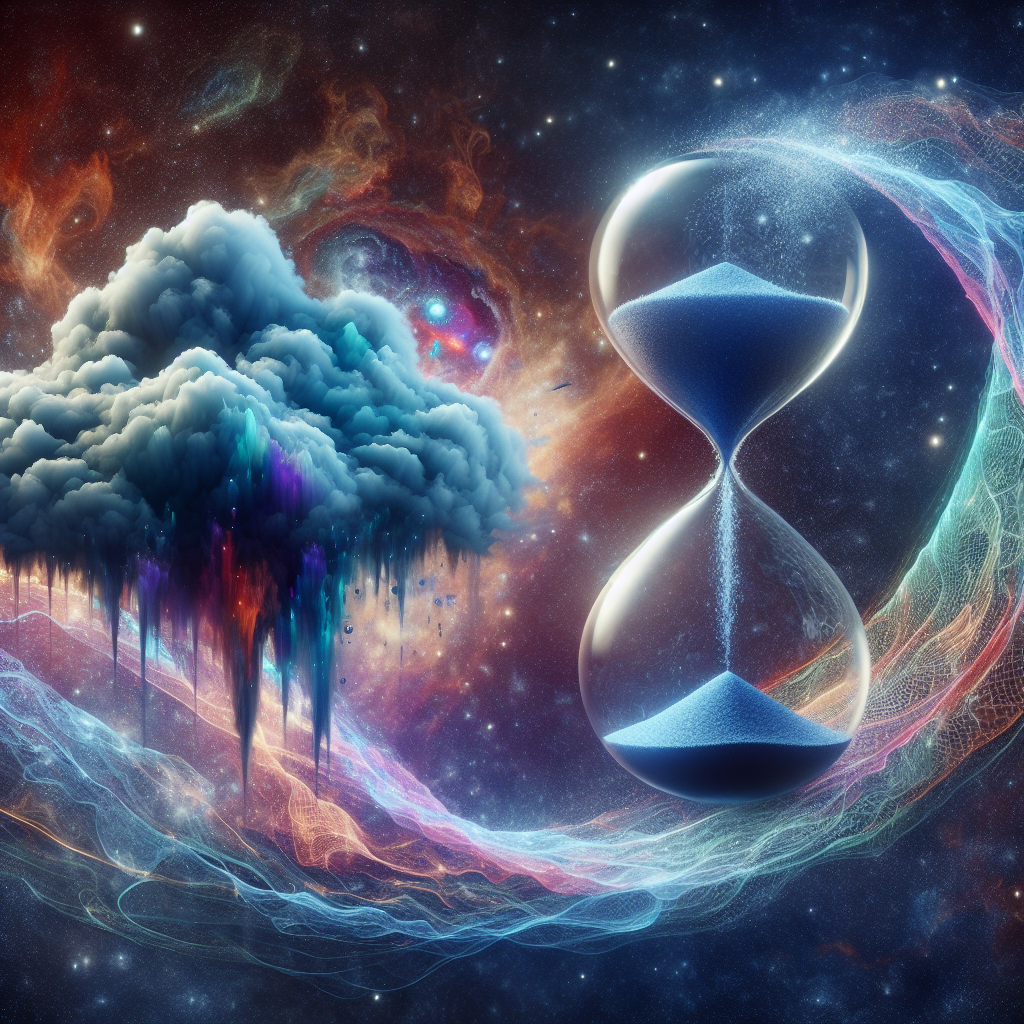
Quantum mechanics is one of the most fascinating and complex theories in modern physics.. Since its development at the beginning of the 20th century, has challenged our understanding of the fundamental nature of the universe and revealed surprising phenomena that defy our intuition.
One of the most intriguing concepts to emerge from quantum mechanics is the role of time.. While in classical physics time is considered an absolute and linear variable, In quantum mechanics the possibility arises that time is not a fundamental property of reality, but rather an emerging illusion of deeper phenomena.
In this presentation we will explore the question: Is time an illusion in quantum mechanics? We will examine the theories and experiments that have challenged our traditional conception of time and delve into the fascinating world of quantum physics to understand how this revolutionary theory can change our perception of time and reality itself.. Join us on this journey to the depths of the quantum universe!!
Discover quantum physics' fascinating explanation of time
Quantum physics offers us a fascinating insight into the concept of time. According to this theory, time is not a fixed and immutable magnitude, but is subject to certain fluctuations and probabilities. In quantum mechanics, Time is considered a dynamic variable that can behave in a non-linear and surprising way..
One of the key concepts of quantum physics in relation to time is the notion of superposition.. According to this idea, a quantum system can exist in multiple states simultaneously, which implies that time is not experienced in a linear and unique way, but it is deployed in multiple possibilities.
Besides, Einstein's theory of relativity also plays an important role in understanding time in quantum mechanics. According to this theory, time and space are intrinsically intertwined, which implies that the perception of time can vary depending on the speed and gravity at which an observer is..
Through concepts such as superposition and relativity, This theory shows us that time is much more complex and fascinating than we imagined.. Discover the true nature of time through quantum physics!
Discover the truth about time: What does it mean it's an illusion?
In quantum mechanics, The concept of time becomes even more intriguing and complex. According to this theory, time is not an independent and absolute entity, but is intrinsically connected to space in what is known as space-time. This idea challenges our intuition about the nature of time and raises the question: Is time an illusion?
To understand this question, It is important to consider how quantum mechanics redefines our understanding of reality. In this theory, events do not occur continuously and deterministically, as in classical physics, but are subject to uncertainty and probability. This means that the notion of past, present and future blurs and it becomes something relative and fluid.
From this perspective, time is not a fundamental property of the universe, but rather a construction of our mind to make sense of the sequence of events. In other words, the time does not have an independent existence and objective, but it is a way of organizing our experience and perception of the world.
Therefore, Saying that time is an illusion does not imply that it does not exist at all., but its nature is more complex than we usually think. In quantum mechanics, time becomes a relative and contextual variable, which can be influenced by various factors, like speed, gravity and the interaction between particles.
It becomes an illusion in the sense that its nature is more complex and subjective than we believe., challenging our traditional conceptions about reality and the universe.
Discover the incredible mechanics of time in the quantum world
>
In the quantum world, time perception is affected in a surprising and complex way. Quantum mechanics shows us that time is not an immutable constant., but is subject to fluctuations and relative positions.
Einstein's theory of relativity teaches us that time and space are intrinsically connected, forming what is known as space-time. In the quantum world, This relationship becomes even more intriguing, since subatomic particles can exist in multiple states simultaneously, which challenges our linear notion of time.
In quantum mechanics, quantum superposition allows a particle to be in different places at the same time, suggesting that time is not experienced linearly, but rather as a series of simultaneous possibilities. This raises the question: Is time an illusion in the quantum world?
The double slit experiments have shown that subatomic particles can behave as waves and particles at the same time, suggesting that their behavior is intrinsically linked to time in a non-linear manner. This challenges our traditional understanding of time as an arrow moving in a specific direction..
It invites us to question our traditional perceptions of time and explore new ways of understanding its nature in a quantum context..
Everything you need to know about the concept of time in mechanics: definition, importance and applications
In quantum mechanics, The concept of time plays a fundamental role in the description of physical phenomena at the subatomic level.. Unlike classical mechanics, where time is considered an absolute and universal magnitude, In quantum mechanics, questions arise about the very nature of time and its role in the universe..
time It is defined as the magnitude that allows events to be ordered in successive sequences, providing a notion of change and evolution in the universe. In quantum mechanics, time is studied from a more complex perspective, where the concepts of simultaneity, duration and causality may not be as clear as in classical physics.
The importance of time in quantum mechanics lies in its role as a fundamental parameter in the equations that describe the behavior of subatomic particles. Time determines the evolution of quantum systems in space and time, allowing to predict and understand phenomena such as quantum superposition, entanglement and uncertainty.
Las applications of the concept of time in quantum mechanics are numerous and range from the prediction of properties of subatomic particles to the development of technologies such as quantum computing.. Understanding the nature of time in the quantum context is essential to advance our knowledge of reality at very small scales..
Is it an illusion? Maybe we won't know for sure, but its influence on the description of the universe at microscopic scales is undeniable.
In conclusion, Time in quantum mechanics remains a fascinating enigma that challenges our traditional understanding. Is it really an illusion? We may never know for sure., But what we do know is that we must continue exploring and questioning our beliefs to expand our scientific horizons.. If you are interested in delving deeper into this exciting topic, I invite you to give away books created by Verbalus Mater, where you will find valuable and stimulating information about the nature of time in the quantum universe. Don't miss the opportunity to enter this mysterious and exciting world!!