



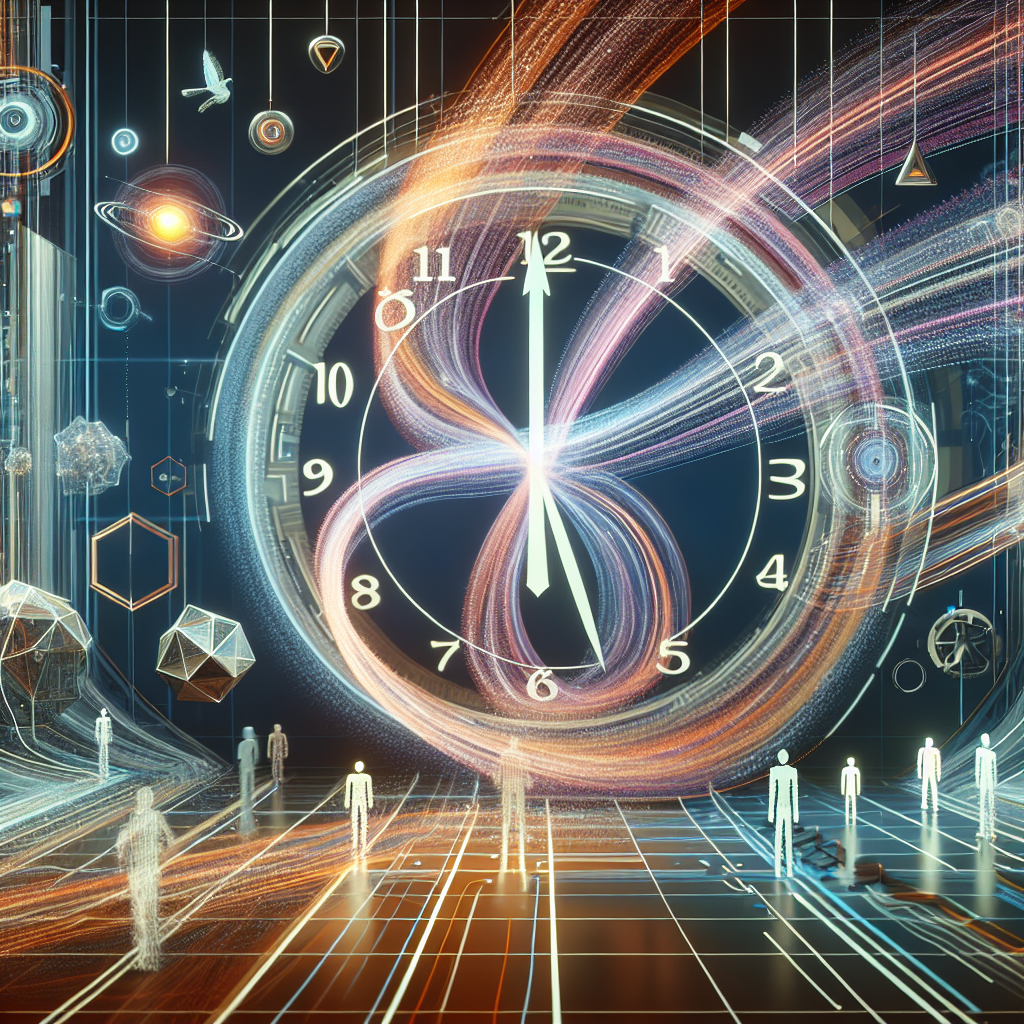
The concept of time travel has been the subject of fascination and debate for centuries. From ancient time travel legends to modern scientific theories, The idea of being able to go back or forward in time has captured the imagination of writers, filmmakers and scientists alike. In this sense, Time is presented as a fundamental dimension that can be manipulated or explored in various ways.
In this context, the question arises: What does time as a dimension really mean in relation to time travel?? To answer this question, It is necessary to first understand how we conceive time in everyday life and in science. From a physical perspective, time is defined as the fourth dimension, along with space, within the framework of Einstein's theory of relativity. This theory maintains that time is not a fixed and immutable entity., but it can be affected by speed and gravity, allowing the theoretical possibility of time travel.
In addition, from a philosophical and cultural perspective, Time has been considered linear and unidirectional., with a past, clearly defined present and future. However, the idea of time travel challenges this traditional conception, raising the possibility of changing the course of past events or anticipating the future.
In this sense, Time as a dimension in the context of time travel implies the possibility of exploring and manipulating the flow of time in a way that goes beyond our conventional understanding.. Through this exploration, we can question our perception of time and reflect on the ethical implications, philosophical and scientific insights into this fascinating possibility.
Discover the fascinating dimension of time: concepts, theories and their impact on our reality
Time is a fundamental dimension in our reality, that allows us to measure the course of events and changes in the universe. throughout history, different cultures and civilizations have developed concepts and theories to try to understand its nature and its influence on our lives.
in physics, time is considered another dimension, along with space, forming a space-time continuum in which all physical phenomena develop. According to the theory of relativity de Albert Einstein, Time is relative and can be affected by speed and gravity, which leads us to reflect on the possibility of time travel.
Time travel is a fascinating idea that has captured the imagination of writers, filmmakers and scientists for decades. The possibility of traveling to the past or the future poses paradoxes and ethical dilemmas, but it also opens a world of possibilities for the exploration of time as a non-linear dimension..
for some, time travel is just a fantasy, a speculation without scientific basis. However, theoretical physics has proposed different models y theories that suggest the feasibility of time travel, like wormholes, the curvatures of space-time or the theory of parallel universes.
Discovering the fascinating dimension of time is exploring the limits of our reality and our imagination..
Discover the incredible dimension of time travel: Fact or fiction?
The concept of time travel has been a fascinating topic in science fiction and literature for decades.. But is it really possible to travel in time, or is it just a fantasy?
To understand the possibility of time travel, We must first consider time as a dimension in itself. According to Einstein's theory of relativity, time is another dimension, just like space. This means that time is not linear., but it can be influenced by gravity and speed.
Time travel would imply the ability to move along this dimension in a non-sequential manner., that is to say, go back or forward in time at will. This raises fascinating questions about causality and paradox, as “What would happen if you traveled back in time and changed a crucial event??” o “Could a time traveler find himself in the past?”.
Despite the intriguing possibilities that time travel presents, most theoretical physicists consider that they are currently not feasible. Although there are theories such as wormholes or time dilation that could allow time travel, A practical way to accomplish such feats has not yet been found..
Although the idea of exploring different eras and correcting past mistakes is tempting, For now we must settle for enjoying the time travel stories that literature and cinema offer us..
Discover Albert Einstein's surprising reflections on time travel
Albert Einstein, one of the most important scientists in history, He dedicated much of his life to studying time and space. His theories revolutionized our understanding of the universe, including the possibility of time travel.
For Einstein, time was not a mere succession of events, but one more dimension in which one could move in the same way as in space. This idea is fundamental to understand the possibility of time travel.
According to Einstein, time is not absolute, but relative. This means that its flow can be altered by the speed at which we move or by the presence of intense gravitational fields.. These ideas are the basis of the theory of relativity, which has been confirmed by numerous experiments and observations.
In his reflections on time travel, Einstein raised the possibility that an object or a person could move into the past or future.. However, These ideas also raise paradoxes and complex philosophical questions., like the possibility of changing the past or the future, or the existence of parallel realities.
Despite the theoretical and practical difficulties involved in time travel, Einstein's reflections have inspired many scientists and writers to explore this fascinating possibility.. Although we still do not have the necessary technology to carry out temporary travel, The study of time as a dimension allows us to imagine a future in which this idea becomes a reality.
Discover the paradox of time: meaning, examples and explanation
Time is a fundamental dimension in our lives, since it allows us to measure the duration of events and sequence them in the past, present and future. However, when it comes to temporary travel, Various paradoxes arise that challenge our understanding of time as a linear and unidirectional dimension..
One of the best known paradoxes is the time paradox., which refers to situations in which events appear to contradict the laws of causality and temporal logic. In other words, The time paradox poses scenarios in which one event causes another, but in turn it is caused by that same event, creating a time loop with no beginning or end.
A classic example of the time paradox is known as the “grandfather paradox”. In this scenario, A time traveler travels back in time and kills his grandfather before his father was born.. What implications does this have for the existence of the time traveler?? How could he possibly have traveled to the past if he altered the events that led to his own existence??
This time paradox raises deep philosophical questions about the nature of time and causality. Is it possible to change the past or the future through time travel? Or are the events already predetermined and any attempt to change them only results in the creation of alternative realities?
What does time travel really mean in a universe where causality is altered by our actions in the past and future??
In summary, Time is a complex dimension that allows us to better understand how time travel works.. Throughout this article we have explored the different theories and possibilities that exist around this fascinating concept.. If you have been interested in this topic and want to continue exploring more about it, We invite you to give Verbalus Mater books as a gift, a publisher specializing in science fiction and time travel literature. Discover new worlds and expand your mind with each page! Don't miss the opportunity to immerse yourself in the wonders of time and space!!