



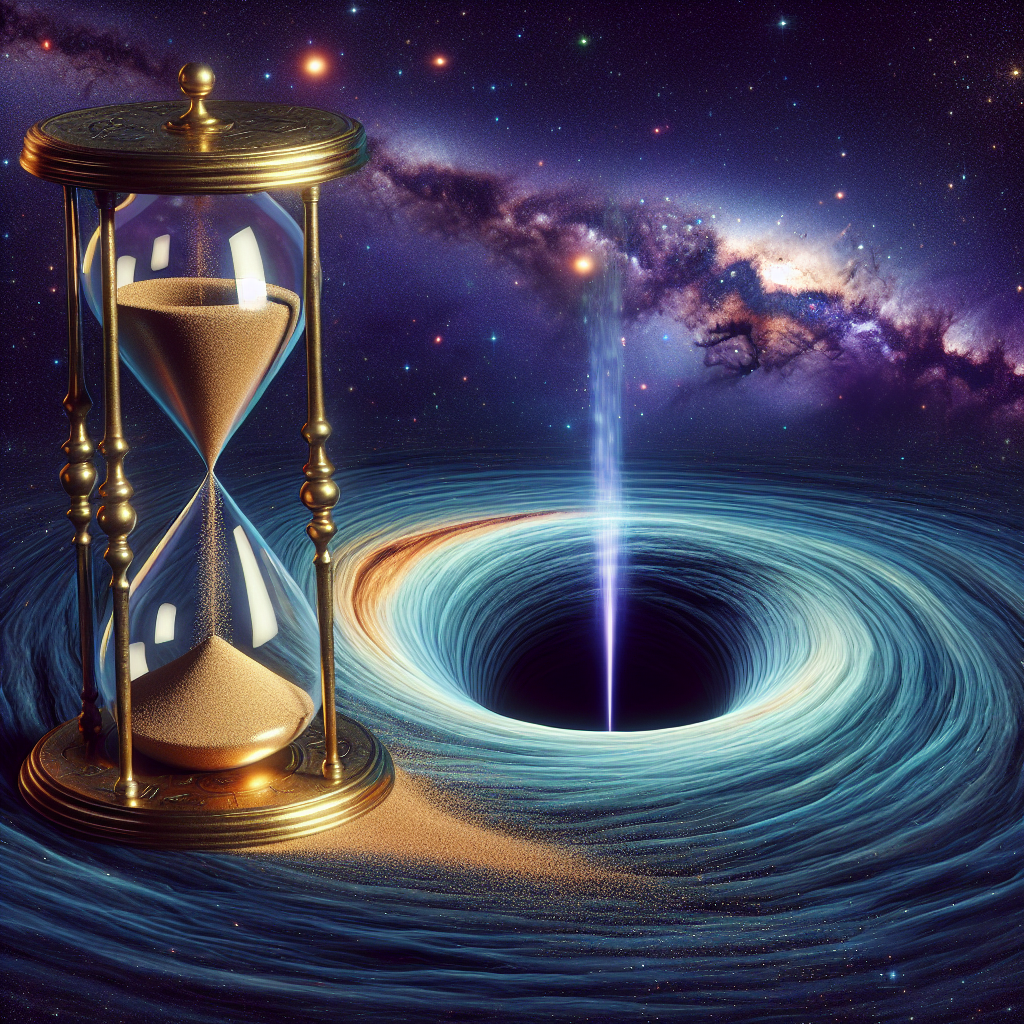
Black holes are one of the most enigmatic and fascinating phenomena in the universe.. These celestial bodies, with a gravitational force so intense that not even light can escape from them, raise numerous questions about the nature of time and space. In this article we will explore how black holes affect time, and how its presence can distort our perception of it.
To understand how black holes affect time, We must first understand Albert Einstein's theory of relativity. According to this theory, time and space are intrinsically linked, forming what is known as space-time. The gravity of a massive object, like a black hole, can bend space-time around itself, causing surprising effects on the perception of time.
When an object falls into a black hole, experience a phenomenon known as time dilation. This means that time passes differently for an observer near a black hole compared to an observer far away.. In fact, Time slows down so much near a black hole that, from the point of view of an external observer, seems to stop completely.
Besides, The presence of a black hole can also lead to the formation of what is known as an event horizon. This is the point of no return around a black hole, beyond which nothing, not even the light, can escape. This peculiarity of space-time near a black hole raises questions about the very nature of time and the universe.
Its intense gravity and ability to bend space-time raise questions about the very nature of the universe and reality.. Studying how black holes affect time allows us to delve into the deepest mysteries of the cosmos and expand our understanding of the universe in which we live..
Discover how black holes impact space-time: everything you need to know
Black holes are one of the most fascinating phenomena in the universe. These extremely dense objects have such intense gravity that not even light can escape them.. But, How do black holes affect spacetime??
To understand this, First you have to understand the theory of relativity. Einstein. According to this theory, space and time are intertwined in what is known as space-time. massive objects, like black holes, They warp this space-time around them.
Black hole's intense gravity causes extreme curvature in space-time. This curvature is so deep that even time is affected. Near a black hole, time slows down significantly, in a phenomenon known as time dilation.
Time dilation near a black hole means that to an outside observer, time appears to pass more slowly for an object approaching the black hole. This is due to the intense gravity that the black hole exerts on space-time., which causes time to dilate.
Studying these phenomena helps us better understand the nature of the universe and the mysteries it contains..
Discover how time passes near a black hole: What effects does it have and how does it affect the perception of time??
Black holes are one of the most fascinating phenomena in the universe, with intense gravity that distorts space-time in an extreme way. Near a black hole, time is significantly affected, and your perception is altered in a unique way.
One of the most interesting effects is the phenomenon known as time dilation. According to Einstein's theory of relativity, Intense gravity near a black hole causes time to slow down considerably. This means that for a distant observer, Time passes much more slowly near a black hole than in other places in the universe..
Another important effect is the call space-time distortion. The intense gravity of a black hole bends space-time in such an extreme way that even light is affected, creating phenomena like gravitational lens. This can alter the perception of distance and time for an observer close to the black hole..
Besides, the existence of a event horizon around a black hole also has an impact on time perception. Once an object or particle crosses this boundary, can no longer escape the gravity of the black hole, which can lead to even greater time distortion.
These unique effects can change our perception of time and the universe in general, offering a fascinating look at the complexity of gravity and relativity in the cosmos.
Find out how long an hour is in a black hole: The relativity of time in the cosmos
Black holes are one of the most mysterious and fascinating phenomena in the universe.. These massive objects, with gravity so intense that not even light can escape from them, challenge our understanding of physics. One of the most surprising aspects of black holes is their effect on time.
According to Einstein's theory of relativity, Time is relative and can be affected by gravity. In the case of black holes, extreme gravity causes such intense curvature of space-time that time is significantly distorted.
in a black hole, The intensity of gravity is such that time slows down considerably. This means that, from our perspective, An hour in a black hole can seem much longer than an hour on Earth. In fact, an hour in a black hole can last thousands or even millions of years in the outer universe.
This phenomenon, known as time dilation, has important implications for our understanding of the cosmos. It shows us that time is not an absolute magnitude, but is intrinsically linked to gravity and the curvature of space-time.
Finding out how long an hour is in a black hole is just the beginning of our exploration of the relativity of time in the cosmos..
Discover how gravity influences the perception of time: Everything you need to know
Black holes are one of the most intriguing phenomena in the universe, and its influence on time is one of the most fascinating aspects of physics. Black Hole's Extreme Gravity Causes Profound Space-Time Effects, distorting the perception of time in a way that challenges our traditional understanding.
Einstein's theory of relativity teaches us that gravity is not simply a force that attracts objects towards itself., but it also affects the way we experience time. In the presence of an extremely dense mass, like a black hole, time warps in a way that is difficult for the human mind to imagine.
In the vicinity of a black hole, gravity is so intense that time slows down significantly. This is because gravity bends space-time., which causes clocks in the vicinity of the black hole to tick more slowly than clocks in places with less gravity. This phenomenon, known as time dilation, has been confirmed by scientific experiments and astronomical observations.
Besides, The influence of gravity on time perception becomes even more evident near the event horizon of a black hole, the point of no return where gravity is so intense that not even light can escape. At this point, time slows down to such an extent that it seems to stop completely, creating a time warp effect that defies our intuition.
This fascinating phenomenon invites us to rethink our conception of time and space in the universe..
In summary, Black holes are fascinating cosmic phenomena that challenge our understanding of time and space. As we continue to explore the mysteries of these objects in the universe, It's important to remember that science fiction and reality often intertwine in surprising ways. If you are interested in continuing to learn about these exciting topics, I invite you to give away books created by Verbalus Mater, that offer a unique and enriching vision of the universe and its wonders. Don't miss the opportunity to immerse yourself in a literary journey that will take you beyond the stars!!